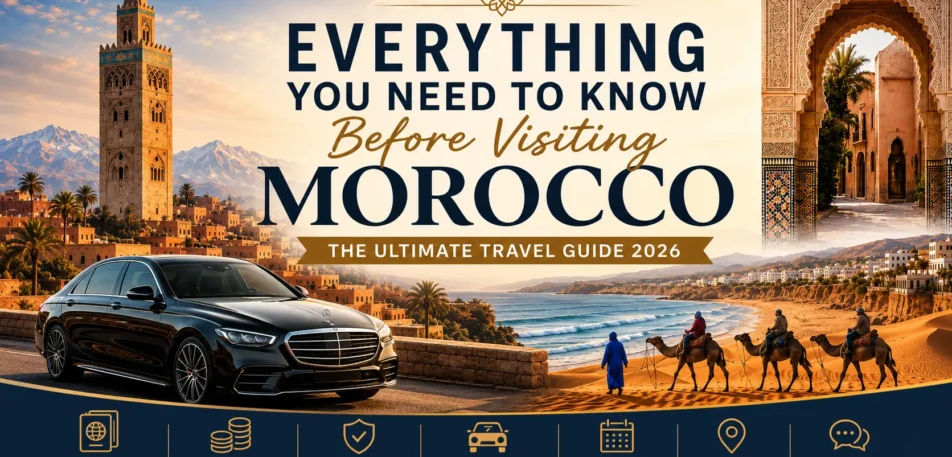
Morocco is one of the most exciting countries to visit because it gives you ancient cities, desert landscapes, Atlantic beaches, mountain routes, luxury riads, colourful souks, and warm hospitality in one trip. Before visiting Morocco, the everything you need to know before visiting Morocco entry rules, currency, transport, local customs, weather, safety, and how you will move between cities.
Morocco is easy to enjoy when your trip is planned properly. The country offers medinas, beaches, mountains, desert routes, cultural cities, and modern business hubs, so the right preparation can turn a normal trip into a smooth and memorable experience. The Moroccan National Tourist Office describes Morocco as a country with coastal regions, mountains, Sahara Desert routes, historic cities, cultural sites, beaches, wellness, shopping, and nature experiences.
Quick Answer: Everything You Need to Know Before Visiting Morocco.
Before visiting Morocco, check your passport and visa rules, carry Moroccan dirhams for smaller payments, plan transport before airport arrival, respect local customs, choose the right season for your route, and stay aware in busy tourist areas. For a comfortable trip, especially for families, business travellers, luxury visitors, and first-time tourists, booking a private chauffeur or airport transfer in advance can make arrival, luggage handling, and city-to-city travel much easier.
1. Passport and visa rules before visiting Morocco
Visa rules for Morocco depend on your nationality, so every traveller should check the latest official entry requirements before booking. The Moroccan National Tourist Office says the maximum tourist stay is 90 days, and extensions can be requested at the nearest police station. For British passport holders, GOV.UK says tourists can visit Morocco without a visa for up to 90 days, and the passport should have an expiry date at least 3 months after the arrival date.
Before flying, make sure your passport is not damaged and that it gets stamped when you enter Morocco. GOV.UK warns that some travellers have had problems leaving Morocco when their passport did not have an entry stamp.
Travel tip: Keep a photo of your passport, hotel booking, airport transfer confirmation, and return flight details on your phone.
2. Best time to visit Morocco
Morocco has different climates depending on where you go. The coast has mild temperatures and strong sunshine for much of the year, while inland areas can feel hotter and more continental. The Atlas Mountains are popular for wide landscapes and trekking, while the Sahara is best visited in spring and autumn because desert heat can be intense.
For most travellers, the best time to visit Morocco is usually March to May or September to November. These months are more comfortable for Marrakech, Fes, desert tours, Atlas Mountain trips, and city sightseeing.
Best season by trip type:
| Trip Type | Best Time |
|---|---|
| Marrakech city break | March–May, September–November |
| Sahara desert trip | Spring or autumn |
| Beach holiday | Spring, summer, early autumn |
| Atlas Mountains | Spring, summer, autumn |
| Business travel | Year-round |
| Luxury private tours | Year-round with planned transport |
3. Moroccan currency and payments
The official currency of Morocco is the Moroccan dirham, usually written as MAD or DH. Common banknotes include 20, 50, 100, and 200 dirhams. Coins include 0.50, 1, 2, 5, and 10 dirhams, plus smaller centime coins.
Credit cards are accepted in many hotels, restaurants, shops, and petrol stations, but cash is still useful for small shops, markets, tips, local taxis, and rural areas. The Moroccan National Tourist Office says exchange offices are available in airports, hotels, banks, and cities, and passports may be required for exchange transactions.
Simple rule: Use cards for hotels and premium services, but keep cash for souks, small cafés, tips, and short local expenses.
4. Languages spoken in Morocco
Morocco has two official languages: Arabic and Amazigh. French is also widely spoken and understood, while Spanish is common in some northern and southern regions. The everyday spoken Moroccan Arabic dialect is called Darija, and it includes influences from Arabic, Amazigh, French, and Spanish.
Useful Moroccan words:
| English | Darija |
|---|---|
| Hello | Salam |
| Thank you | Chokran |
| Welcome | Marhba |
| Goodbye | Beslama |
| How much? | Bch’hal? |
In luxury hotels, airports, restaurants, and tourist areas, English is becoming more common, but learning a few local words helps create a better connection.
5. Is Morocco safe for tourists?
Morocco is a popular tourist destination, but travellers should still stay alert, especially in busy markets, tourist areas, transport hubs, and large public spaces. The U.S. Department of State currently lists Morocco as Level 2: Exercise Increased Caution due to terrorism risk and advises travellers to stay alert in tourist locations and avoid demonstrations and crowds.
For normal tourist travel, the most common issues are usually not major danger but small travel problems: overpaying, unplanned transport, crowded medinas, confusion at arrival, or weak itinerary planning.
Practical safety tips:
- Book airport pickup before landing.
- Avoid carrying too much cash in crowded areas.
- Use official guides or trusted tour providers.
- Keep your hotel address saved offline.
- Do not follow random street “guides”.
- Use planned transport for late-night arrivals.
For families, VIP guests, business travellers, and first-time visitors, a private chauffeur can reduce a lot of stress because you do not need to negotiate taxis, manage luggage alone, or guess directions after a long flight.
Is It Safe to Hire a Private Chauffeur in Morocco?
6. Getting around Morocco
Morocco has several travel options, including taxis, trains, coaches, car rentals, shuttle buses, and private drivers. The Moroccan National Tourist Office says that at airport exits, travelers can take shuttle buses or taxis or contact car rental agencies.
For longer routes, Morocco has a high-speed train service serving Tangier, Kenitra, Rabat, and Casablanca. The same source notes travel times such as Tangier to Casablanca in around 2h10 and Rabat to Tangier in around 1h20. Regular trains also connect many main cities, including Marrakech and Oujda, although some cities such as Agadir are not covered by rail.
Inside cities, taxis are common and often identified by color, such as red taxis in Casablanca and Agadir, blue taxis in Rabat and Tangier, and orange taxis in Marrakech.
Private chauffeur vs taxi in Morocco
A taxi can work for short city rides, but a private chauffeur is better for airport transfers, luxury travel, business trips, family travel, multi-city routes, desert transfers, and special occasions.
| Option | Best For | Main Issue |
|---|---|---|
| Local taxi | Short city rides | Price negotiation, luggage limits, comfort vary. |
| Train | Major city routes | Not door-to-door |
| Rental car | Independent travelers | Parking, traffic, unfamiliar roads |
| Private chauffeur | Airport, luxury, business, family, long routes | Needs advance booking |
For visitors who want comfort, privacy, clean vehicles, and a smoother arrival, private transfers are usually the better choice.
For a smoother arrival, link this section to your Morocco Airport Transfers page.
7. What to wear in Morocco
Morocco is modern and tourist-friendly, but it is still a culturally traditional country. In big cities and resorts, visitors wear many different styles, but modest clothing is a respectful choice, especially in medinas, rural areas, religious surroundings, and local neighbourhoods.
For women, light trousers, long skirts, dresses, linen shirts, and a scarf for some settings are useful. For men, linen shirts, polos, trousers, and smart casual clothing work well. For desert and mountain trips, bring comfortable shoes, sunglasses, sun protection, and layered clothing.
Packing tip: Morocco can feel hot during the day and cooler at night, especially in desert and mountain areas, so light layers are smart.
8. Food, water, and health tips
Moroccan food is one of the biggest reasons people love the country. Popular dishes include tagine, couscous, grilled meats, fresh bread, mint tea, seafood, olives, dates, and pastries.
For health, the Moroccan National Tourist Office recommends basic food-safety habits such as washing hands before eating, washing and peeling fruits and vegetables, making sure meat is well cooked, and avoiding long sun exposure. It also says no additional vaccination is required apart from universal vaccinations, although some vaccines may be useful depending on the traveler and the type of trip.
Simple food tips:
- Drink bottled water if your stomach is sensitive.
- Eat at busy, clean restaurants.
- Be careful with raw salads from unknown places.
- Carry basic stomach medicine.
- Use sunscreen, especially in Marrakech, desert areas, and coastal cities.
9. Internet, SIM cards, and useful apps
Morocco has good mobile coverage in many areas. The Moroccan National Tourist Office says the network is generally well covered, and travellers can buy a Moroccan SIM card if their phone is unlocked. Many hotels, cafés, restaurants, and airports offer Wi-Fi.
Useful apps include weather apps, train information apps, coach booking apps, pharmacy apps, Google Maps, WhatsApp, and translation apps. For premium travel, WhatsApp is especially useful because many local businesses, drivers, hotels, and tour operators use it for fast communication.
10. Best places to visit in Morocco
Morocco is not a one-city destination. Each region gives a different kind of trip.
Marrakech
Marrakech is one of Morocco’s most famous cities, known for luxury riads, gardens, souks, food, nightlife, and access to the Atlas Mountains and Agafay Desert. It is ideal for first-time visitors, couples, families, and luxury weekend trips.
Casablanca
Casablanca is Morocco’s business hub and a major arrival point for international travellers. It is best for business travel, coastal stays, premium dining, and transfers to Rabat, Marrakech, or northern Morocco.
Rabat
Rabat is the capital city and has a calmer, more polished feel. It is good for business travellers, embassies, government visits, cultural sites, and relaxed coastal travel.
Fes
Fes is one of the best cities for history, old medinas, traditional crafts, and deep cultural experiences. It is perfect for travellers who want heritage over nightlife.
Chefchaouen
Chefchaouen is famous for its blue streets and mountain setting. It is one of the most photogenic places in Morocco and works well as part of a northern Morocco route.
Essaouira
Essaouira is a relaxed Atlantic coastal city with seafood, beaches, art, and a slower pace. It is ideal after a busy Marrakech stay.
Agadir and Taghazout
Agadir and Taghazout are better for beach holidays, surfing, wellness, and sunshine. The Moroccan National Tourist Office notes Agadir as a major seaside resort with around 300 days of annual sunshine.
Sahara Desert
The Sahara is one of the most powerful travel experiences in Morocco. Spring and autumn are better seasons for desert travel because the weather is more comfortable.
11. Suggested Morocco itinerary for first-time visitors
5-Day Morocco Trip
Day 1: Arrive in Marrakech
Day 2: Marrakech medina, gardens, food experience
Day 3: Atlas Mountains or Agafay Desert
Day 4: Essaouira day trip or luxury spa day
Day 5: Airport transfer and departure
7-Day Morocco Trip
Day 1: Casablanca arrival
Day 2: Rabat city visit
Day 3: Fes
Day 4: Fes cultural tour
Day 5: Marrakech
Day 6: Atlas Mountains or Agafay Desert
Day 7: Departure
10-Day Morocco Trip
Day 1: Casablanca
Day 2: Rabat
Day 3: Chefchaouen
Day 4: Fes
Day 5: Fes
Day 6: Sahara route
Day 7: Desert experience
Day 8: Marrakech
Day 9: Marrakech or Essaouira
Day 10: Departure
For longer routes, private transport helps because Morocco is beautiful, but distances between cities can be long.
12. Why airport transfers matter in Morocco
Your first experience in Morocco usually starts at the airport. After a long flight, the last thing most travellers want is confusion about taxis, luggage, language, pricing, or directions.
A pre-booked airport transfer gives you:
- Driver waiting at arrivals
- Help with luggage
- Fixed pickup plan
- Clean private vehicle
- Direct transfer to hotel or riad
- Better comfort for families and VIP guests
- Easier late-night arrivals
- No need to negotiate after landing
This is especially useful in Marrakech, Casablanca, Rabat, Tangier, Fes, and Agadir.
13. Morocco travel guide mistakes to avoid
Many first-time visitors make small mistakes that can affect the trip.
Avoid these:
- Arriving without airport pickup
- Not carrying cash
- Overpacking heavy clothes
- Trying to visit too many cities in a short trip
- Forgetting travel insurance
- Not checking passport validity
- Relying only on taxis for long-distance travel
- Booking desert trips without understanding distance
- Not planning Friday, Ramadan, or public holiday timing
- Wearing uncomfortable shoes in medinas
The smartest way to enjoy Morocco is to plan less, but plan better.
14. Final travel checklist before visiting Morocco
Before your trip, make sure you have:
- Valid passport
- Visa checked by nationality
- Travel insurance
- Hotel or riad booking
- Airport transfer confirmation
- Moroccan dirhams or exchange plan
- Unlocked phone for SIM/eSIM
- Comfortable walking shoes
- Modest lightweight clothing
- Sunglasses and sunscreen
- Copies of travel documents
- WhatsApp access
- Private driver details for long routes
Conclusion
Morocco is a beautiful country for culture, luxury travel, business trips, family holidays, desert adventures, beaches, food, and history. The trip becomes much easier when you understand the basics before arrival: passport rules, currency, weather, transport, language, safety, and local customs.
For a smooth experience, plan your airport transfer before you land, choose the right season for your route, keep cash for small purchases, and use trusted transport for longer journeys. Morocco is not just a place to visit. It is a place to feel from the quiet desert sunrise to the sound of the medina, from mint tea in a riad to a private drive through the Atlas Mountains.
Arriving in Morocco soon? Book a private airport transfer or luxury chauffeur service in advance and start your trip with comfort, privacy, and peace of mind.
FAQs
Do I need a visa to visit Morocco?
Visa requirements depend on your nationality. Many tourists can visit for up to 90 days, but travellers should always check the latest official rules before booking. GOV.UK says British passport holders can visit Morocco without a visa for up to 90 days.
What is the best time to visit Morocco?
The best time for most visitors is spring or autumn, especially for Marrakech, Fes, the Atlas Mountains, and the Sahara. The Moroccan National Tourist Office says spring and autumn are best for venturing into the Sahara.
Is Morocco safe for tourists?
Morocco is widely visited by tourists, but travellers should stay alert in tourist areas, avoid demonstrations, and take normal safety precautions. The U.S. Department of State advises increased caution in Morocco due to terrorism risk.
What currency is used in Morocco?
Morocco uses the Moroccan dirham, abbreviated as MAD or DH. Cash is useful for markets, taxis, tips, and smaller shops.
Can I use credit cards in Morocco?
Yes, cards are accepted in many hotels, restaurants, shops, and petrol stations, but cash is still important for smaller payments.
What languages are spoken in Morocco?
Arabic and Amazigh are the official languages. French is widely spoken, Spanish is common in some regions, and Darija is the everyday Moroccan Arabic dialect.
Is a private driver worth it in Morocco?
Yes, a private driver is worth it for airport transfers, luxury travel, family trips, business visits, desert routes, and city-to-city travel. It saves time, reduces stress, and gives a more comfortable door-to-door experience.
How many days are enough for Morocco?
Five days is enough for Marrakech and a short day trip. Seven days is better for Marrakech, Fes, Casablanca, or Rabat. Ten days is ideal for a wider route including the Sahara or northern Morocco.